

Quick Answer: The most common GD meaning is “Good Day” as a casual greeting, or “God Damn” as an exclamation of surprise or frustration. It also has specific meanings in education (Grade), medicine, and law enforcement.
You’re scrolling through a group chat and someone drops a lone “GD” with no context. Is it a greeting? A curse? A grade on a test? Texting slang loves to recycle two-letter combos, and GD is one of the trickiest because its meaning flips entirely based on tone, punctuation, and where you see it.
This guide breaks down the full GD meaning — from everyday texting to school report cards to police paperwork — so you never have to guess again.
🔑 Key Takeaways
- GD = Good Day when used as a greeting, usually at the start of a message.
- GD = God Damn when used as an exclamation, usually mid-sentence or as a reaction.
- In education, GD often stands for Grade or Group Discussion (common in exams and interviews).
- In medical charts, GD can refer to terms like Gestational Diabetes or Gravida depending on specialty.
- In police and legal reports, GD usually means General Diary — a daily record log.
- Context, capitalization, and surrounding words are the fastest way to decode which GD you’re reading.
🧭 Which GD Do You Mean? (Pick Your Context)
Not sure which GD meaning applies to your text? Use this quick context check.
Greeting Someone? → It’s “Good Day”
If GD shows up at the start of a message, especially in a formal or semi-formal tone, it almost always means Good Day. It works like “hi” or “hello” but with a slightly old-fashioned, polite edge.
Reacting to Something? → It’s “God Damn”
If GD appears as a standalone reaction to shocking, funny, or frustrating news, it’s short for God Damn. Think of it as a milder, typed-out version of swearing under your breath.
In School or Grades? → It’s “Grade” (GD)
In academic settings, GD frequently refers to a Grade on an assignment or a Group Discussion round in interviews and entrance exams, especially common in Indian education and MBA admissions.
Medical or Legal Document? → It’s a Technical Abbreviation
In clinical notes or official reports, GD is shorthand for specific technical terms unrelated to casual texting — always read it within its professional context.
💬 GD in Everyday Texting

Texting slang thrives on brevity, and GD fits perfectly into fast-paced conversations. When people search for the GD meaning in chats, it almost always comes down to these two dominant interpretations.
GD = Good Day
Used as a friendly opener or sign-off, this version of GD is warm and low-effort. It’s common in workplace chats, customer service messages, and casual acquaintances checking in.
Example: “GD! Hope your week’s off to a good start.”
GD = God Damn
This version carries emotional weight — surprise, disbelief, frustration, or even admiration. It’s the internet’s shorthand for an audible gasp.
Example: “GD, I can’t believe they cancelled the concert.”
Real Text Examples
| Message | Meaning of GD |
|---|---|
| “GD, good morning everyone!” | Good Day |
| “GD it’s already 2am and I haven’t slept” | God Damn |
| “GD that traffic was insane today” | God Damn |
| “Just wanted to say GD, see you at the meeting” | Good Day |
| “GD! You actually did it!” | God Damn (excited) |
🎓 GD in Education, Medicine & Law
Outside of texting, GD carries entirely different meanings depending on the professional field.
GD Meaning in Education (Grading)
In academic contexts, GD can stand for Grade on report cards, or Group Discussion, a common evaluation round in college admissions and job interviews, particularly across South Asian education systems.
GD Meaning in Medical Contexts
Healthcare professionals may use GD as shorthand within charts or notes, with the exact meaning depending entirely on the specialty and clinic — always confirm with the source document rather than assuming.
GD Meaning in Police/Legal Reports
In law enforcement documentation, GD commonly stands for General Diary, a chronological logbook used by police stations to record daily activities and complaints.
📊 GD Meanings Compared Side-by-Side
| Field | GD Stands For | Typical Use |
|---|---|---|
| Texting/Chat | Good Day | Friendly greeting |
| Texting/Chat | God Damn | Surprise, frustration, emphasis |
| Education | Grade | Report cards, grading scales |
| Education | Group Discussion | Interview/exam rounds |
| Law Enforcement | General Diary | Daily police record logs |
| Medical | Varies by specialty | Clinical shorthand |
📱 GD Meaning on Social Media Platforms
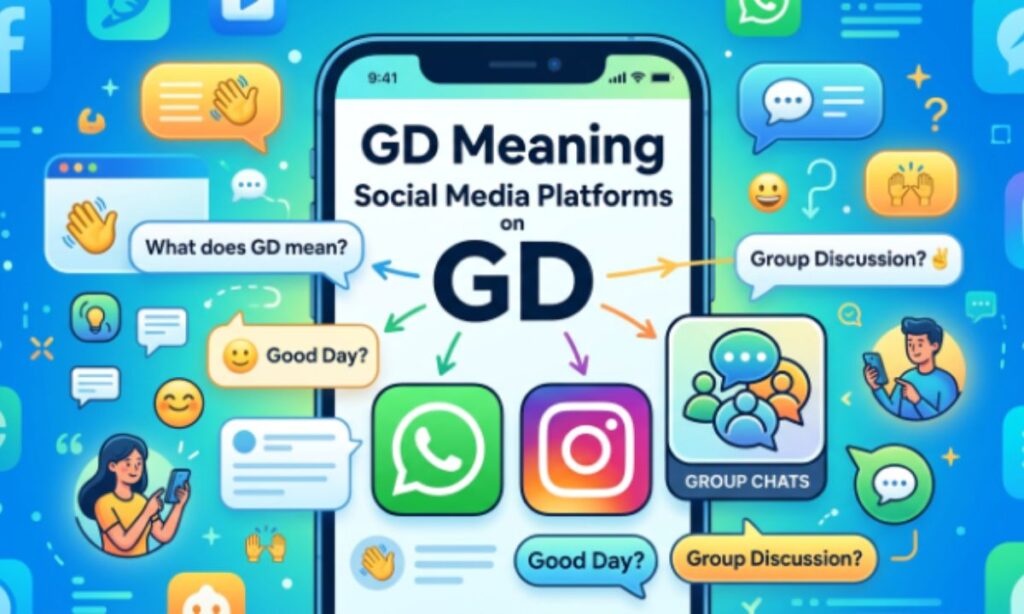
Slang doesn’t behave the same way everywhere — each platform has its own texting culture, and GD adapts accordingly.
💬 On WhatsApp
WhatsApp leans toward the greeting usage, especially in family groups, work chats, and messages sent to acquaintances or professional contacts. “GD” here often opens the message.
💬 On Instagram
Instagram comments and DMs favor the reaction-style GD, used to express shock or hype in response to a post, story, or reel.
💬 In Group Chats
Group chats blend both meanings freely, so context from the surrounding messages is essential. A GD dropped after a funny screenshot is almost never a greeting.
🧩 Tone & Style Across Platforms
Younger, faster-paced platforms like Snapchat and TikTok comments favor the exclamatory “God Damn” tone, while more formal or professional messaging apps favor the polite “Good Day” greeting.
🧠 Is GD Friendly or Rude?

Whether GD comes across as friendly or rude depends entirely on which GD meaning is being used and who’s reading it.
😊 Friendly
As “Good Day,” GD is polite, neutral, and safe to use with almost anyone, including coworkers, teachers, or people you don’t know well.
😐 Neutral
In casual banter between friends, “God Damn” often reads as harmless emphasis rather than an actual curse, similar to saying “wow” or “no way.”
😠 Strong/Surprised
In more sensitive settings, GD as “God Damn” can come across as mildly offensive or overly casual, especially to older audiences or in formal writing.
🚦 Should You Use GD Here?
Context determines whether GD is a safe choice or a risky one.
✅ Good Times to Use It
- Texting close friends who already use casual slang
- Reacting to surprising news in informal group chats
- Greeting someone casually at the start of a message
❌ When to Hold Back
- Professional emails or formal business communication
- Messages to elders, teachers, or religious contacts who may find “God Damn” disrespectful
- First-time conversations where tone hasn’t been established yet
🔁 Similar Slang Words or Alternatives to GD
If you want to switch things up, these alternatives carry similar meanings:
- HAGD – Have A Good Day
- OMG – Oh My God (similar reaction energy to “God Damn”)
- SMH – Shaking My Head (for frustration)
- FR – For Real (for emphasis/agreement)
- DAMN – Spelled out fully, for stronger emphasis
- GM – Good Morning (similar greeting style to “Good Day”)
⚡ Quick-Fire Q&A
What Does GD Stand For in Texting?
GD most often stands for “Good Day” or “God Damn,” depending on how it’s used in the sentence.
What Does GD Mean in Chat?
In chat apps, GD usually functions as either a quick greeting or a short emotional reaction to something surprising.
What Is the Full Form of GD?
The most common full forms are “Good Day” and “God Damn,” though education and legal fields have their own separate definitions.
What Does “You GD” Mean in Text?
“You GD [something]” typically uses GD as an intensifier before an insult or complaint, similar to using “damn” for emphasis.
Is GD Rude?
It can be mildly rude when used as “God Damn,” especially with people who aren’t familiar with casual texting slang.
Can GD Be Used Professionally?
Yes, but only as “Good Day” — the greeting version is appropriate for polite, semi-formal communication.
Where Is GD Most Popular?
GD is widely used across English-speaking texting culture, with the “Group Discussion” meaning especially common in South Asian academic contexts.
Can Emojis Clarify GD Meaning?
Yes — pairing GD with a 😊 or ☀️ suggests “Good Day,” while 😱 or 😤 signals “God Damn.”
🧾 Final Thoughts
Understanding the GD meaning is a perfect example of how a simple two-letter abbreviation can carry completely different meanings depending on where, when, and how it’s used.
In everyday texting, it almost always boils down to a friendly “Good Day” or an emotional “God Damn” — while classrooms, hospitals, and police stations each have their own specialized versions entirely.
The next time GD pops up in your messages, check the tone, the platform, and the sentence around it. Once you know the context, decoding GD becomes second nature — and you’ll never send (or receive) an awkwardly misread text again.
