

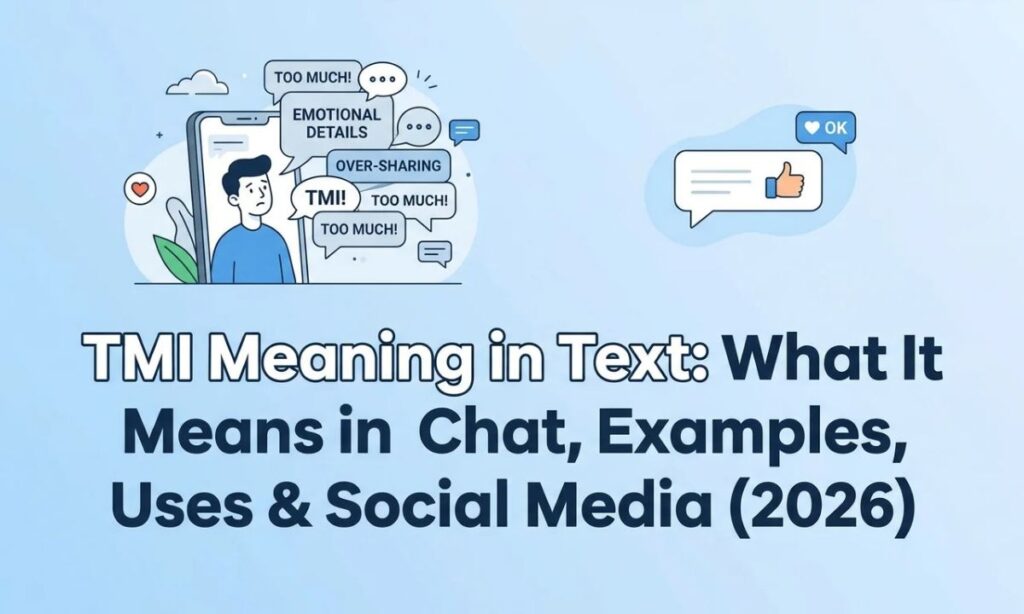
Your friend sends a long message about a stomach bug, and your reply is one word: “TMI.” Maybe you just wanted to say you did not need those details. Maybe you were joking. Maybe you were a little grossed out.
That is why the TMI meaning matters. It is short, common and easy to misread. This guide explains what it means, where it came from, how people use it on every major app, and how to reply when someone says it to you.
What Does TMI Mean in Text & Chat?
Quick Answer
TMI means “too much information.” People use it in texts and on social media when someone shares details that are too personal, too graphic or simply unnecessary. It can be a joke, a playful warning or a polite way to say “I did not need to know that.”
Key Takeaways
- TMI stands for “too much information.”
- It is used to react to oversharing or to warn before sharing.
- The tone can be funny, friendly or mildly critical.
- The TMI meaning stays the same across WhatsApp, Instagram, TikTok and Snapchat.
- It works in casual chats but not in formal writing.
- In K-pop fandoms, TMI often means fun trivia, not oversharing.
Full Form, Stands For & Short Meaning of TMI
Short Meaning of TMI
The short TMI meaning is simple: you shared more than anyone asked for. It signals a boundary without a long explanation.
What Does TMI Stand For in Chat?
In chat, TMI stands for “too much information.” Some people type it in capitals, and others write “tmi” in lowercase. Both versions mean the same thing. You will also see it at the start of a message, as in “TMI, but I just cried at a dog food commercial.” That use is a warning, not a complaint.
Origin, History & First Known Use of TMI
The phrase “too much information” is older than texting. People used it in everyday speech long before phones had keyboards. The abbreviation gained ground in the 1990s and spread quickly once chat rooms, text messages and early social networks arrived.
Short forms win online because typing is slow and attention is short. Three letters beat four words every time. By the 2000s, TMI had become standard internet slang, and it has stayed in everyday use since then. Online dictionaries and slang sites now list it as a common reaction to oversharing.
How People Use TMI in Daily Conversations
Texting Examples
- “He told me his whole medical history on the first date. TMI.”
- “TMI, but I haven’t showered in two days.”
- “Okay, that is TMI. I’m eating.”
Social Media Usage
On social media, TMI often appears in comments and captions. Creators use it to joke about their own oversharing, as in “TMI Tuesday” posts. Followers use it to react to a story that went too far.
Casual, Everyday Situations
In real life, many people say the letters out loud. Someone shares a gross detail at lunch, and a friend says “T-M-I!” with a laugh. The tone is usually light.
TMI Meaning Across Social Media Platforms
TMI Meaning on WhatsApp
On WhatsApp, TMI shows up in private chats and group threads. It works as a quick nudge when a family or friend chat gets too detailed. A short “TMI lol” keeps things friendly.
TMI Meaning on Instagram
On Instagram, the TMI meaning stays the same. You will find it in comments, replies to stories and DMs. Many users also add it to captions before a personal confession.
TMI Meaning on TikTok
TikTok creators use TMI in videos that reveal quirky personal facts. A caption such as “TMI but I sleep with socks on” invites viewers to laugh, relate or share their own habits.
TMI Meaning on Snapchat
On Snapchat, TMI means the same thing: too much information. Friends send it as a reply to a snap that revealed more than expected.
Does the Meaning Change by Platform?
No. The meaning stays the same everywhere. Only the tone shifts. Private chats feel more casual, while public comments may feel sharper.
What Does TMI Mean From a Girl or Guy?
Gender does not change the definition. What changes is the situation and the relationship.
TMI Meaning From a Girl
When a girl says TMI, she usually means one of three things:
- She heard a detail she did not want.
- She is teasing you.
- She is warning you before she overshares.
Look at emojis and timing. A laughing face suggests a joke.
TMI Meaning From a Guy
From a guy, TMI is usually playful, especially among friends. It can also work as a gentle way to change the subject without starting an argument.
What Does TMI Mean in a Relationship?
In a relationship, TMI marks a comfort limit. A partner might say it when a story is too graphic, or you might say it before sharing something awkward. Used kindly, it keeps communication honest. Used harshly, it can make someone feel shut down, so tone matters.
TMI Meaning in Other Fields
TMI Meaning in Medical Contexts
In a doctor’s office, there is no such thing as too much information about your symptoms. Do not hold back details because you fear sounding like you are oversharing. Some clinics also use TMI as shorthand for technical terms, so ask what it stands for if you see it on a form.
TMI Meaning in K-pop
In K-pop fandoms, the TMI meaning leans positive. Fans share TMI about idols, meaning small, fun facts such as favorite snacks or odd habits. Here it is a treat, not a complaint.
TMI in Gen Z Slang
Gen Z often uses TMI as a joke. People type “TMI but” before a silly confession. It is self-aware humor, not a real warning.
Common Confusions, Mistakes & Wrong Interpretations
Many people assume TMI is always negative. It is not. It can be playful, affectionate or even proud. Others think it is rude by default, but tone decides.
Common Mistakes (TMII, TMIF, TMIT: Are They Real?)
No. TMII, TMIF and TMIT are not recognized slang. They are almost always typos. If you see one, treat it as TMI. If someone is clearly using a new meaning, simply ask what they meant.
Similar Terms, Alternatives & Related Slang
TMI sits among several related terms. Here is how they compare.
| Term | Meaning | Example |
|---|---|---|
| TMI | Too much information | “TMI, I’m eating.” |
| Oversharing | Telling more than needed | “She was oversharing again.” |
| TBH | To be honest | “TBH, I’m tired.” |
| FYI | For your information | “FYI, I’m late.” |
| TL;DR | Too long, didn’t read | “TL;DR: we won.” |
| NSFW | Not safe for work | “Careful, that clip is NSFW.” |
TMI reacts to what was shared. TBH and FYI introduce what is about to be shared. TL;DR summarizes long text.
Examples of TMI in Real Chat Situations
Chat 1: Friends
Zoe: Just got back from the dentist. They pulled the whole tooth and it was gross.
Mark: TMI. I’m having lunch.
Zoe: Sorry, lol.
Chat 2: Warning first
Ben: TMI, but I just talked to my plant for ten minutes.
Ana: Honestly, same.
Chat 3: Work group
Lena: Quick reminder: please keep personal medical details out of this channel.
Sam: Understood. That was TMI, sorry.
How to Reply When Someone Says TMI
Casual Replies
- “Fair, I’ll stop.”
- “Okay, noted.”
- “Too much? Got it.”
Funny Replies
- “You asked how I was!”
- “You’re welcome for the free entertainment.”
- “I have no filter, sorry.”
Friendly Replies
- “Sorry, I got carried away.”
- “Thanks for telling me. Changing the subject.”
- “I’ll keep that for my diary.”
Formal Replies
- “Understood. I will keep future messages brief.”
- “Thank you for the feedback. I will be more mindful.”
Is TMI Still Popular? Trends, Usage & Urban Dictionary Definitions
Is Usage Growing or Declining?
TMI is steady. It is not a trend that spiked and vanished. It is a durable piece of everyday slang, and online dictionary entries still describe it the same way: a reaction to too much personal detail.
Who Uses TMI Most? (Social Media & Friendship Contexts)
Teens and young adults use it most, especially in friend groups and fan communities. Still, plenty of older adults use it too, since it appeared before today’s apps.
Where Is TMI Commonly Seen Online?
- Text messages and group chats
- Instagram comments and DMs
- TikTok captions and replies
- Snapchat conversations
- Fan forums and K-pop communities
Quick Facts About TMI
- Full form: Too much information
- Type: Texting and internet slang
- Tone: Funny, casual, sometimes critical
- Best for: Friends and informal chats
- Avoid in: Formal emails and professional writing
- Other meaning: Three Mile Island, in history and news
FAQs
What does TMI mean on Snapchat?
On Snapchat, TMI means “too much information.” It is a quick reaction to an overshare.
Is TMI rude?
Not usually. Among friends it is a joke, but a harsh tone can make it feel dismissive.
What does TMI mean from a girl?
It usually means she heard more than she wanted, she is teasing you, or she is warning you before she overshares.
What does TMI mean from a guy?
Most often it is playful, a casual way to say “I did not need that detail.”
Is TMI positive or negative?
It is neutral. Context decides if it sounds funny, annoyed or affectionate.
Can TMI be used professionally?
Rarely. Spell out “that is more detail than needed” in work messages.
What is TMI in Gen Z slang?
Gen Z uses it as a joking lead-in to a silly confession, such as “TMI but I talk to my plants.”
What else could TMI stand for?
The best-known alternative is Three Mile Island. Some fields also use TMI as shorthand for technical terms.
Is TMI still used today?
Yes. It remains common in texts, comments and group chats.
Conclusion
The TMI meaning is easy once you know the context. It stands for “too much information,” and people use it to react to oversharing, to warn before a confession or to joke around. The tone changes with the person and platform, but the core idea stays the same.
Use it with friends, skip it in formal writing, and pay attention to how it lands. Tone, emojis, and timing shape the TMI meaning far more than the letters themselves. Next time someone drops a very personal detail, you will know exactly what to say, and you can say it kindly.
