

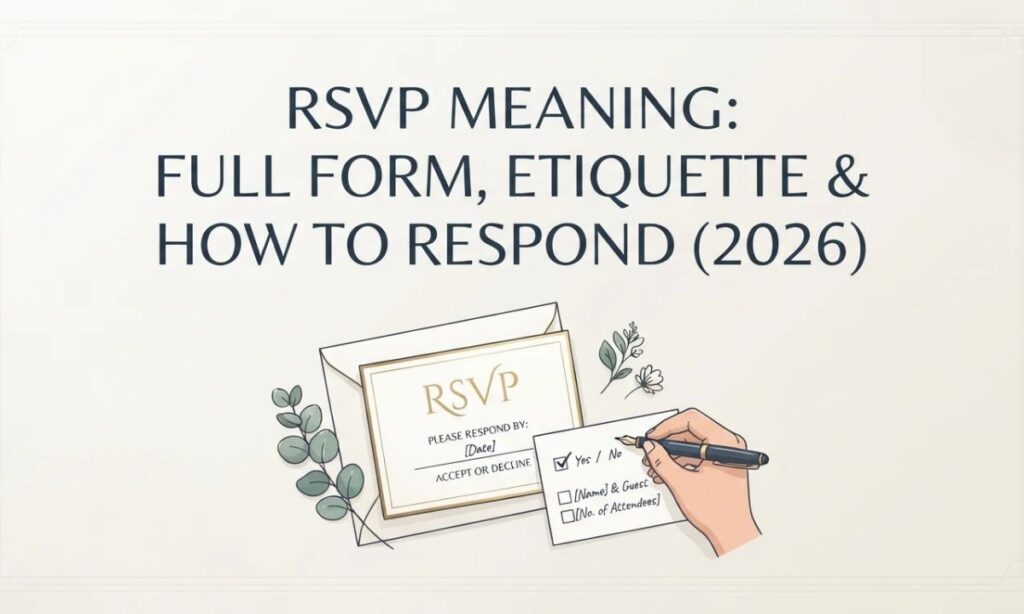
You open an invitation, love the idea of the party and then notice three letters at the bottom: RSVP. Reply now, or later? Do you answer if you can’t go? What if the host wants a text and you send an email?
Those small questions cause real stress for guests and hosts. This guide explains the RSVP meaning, where it comes from, and how to respond politely in every common situation, from weddings to casual group chats.
RSVP Meaning: Quick Answer
Quick Answer
The RSVP meaning is “please respond.” RSVP stands for the French phrase “répondez s’il vous plaît,” which asks guests to tell the host whether they will attend. Reply by the deadline, whether your answer is yes or no. That is the practical RSVP meaning.
Key Takeaways
- RSVP is short for “répondez s’il vous plaît,” French for “please respond.”
- The RSVP meaning is a request to reply, not just a label on an invitation.
- Reply by the host’s deadline, and use the method the host asks for.
- “Regrets only” means reply only if you cannot attend.
- Tell the host about plus-ones, children and dietary needs when you respond.
- If your plans change, tell the host as soon as you know.
What Does RSVP Stand For?
The French Origin (Répondez S’il Vous Plaît)
The letters come from the French phrase “répondez s’il vous plaît,” which means “please respond” or, more literally, “respond, if you please.” The abbreviation is used in English as both a noun (“I need your RSVP”) and a verb (“Please RSVP by Friday”).
The RSVP meaning stays the same in every use. It is a polite request for an answer.
History of RSVP in Formal Invitations
French was long seen as the language of culture and good manners, so English-speaking hosts borrowed the phrase for formal invitations. Traditional invitations often included a reply card and a return envelope, and the card carried the RSVP request.
Today the same request appears on printed cards, emails, event pages and group chats. The format has changed, but the purpose has not. The formal tradition also explains why wedding invitations still often say “The favor of a reply is requested.”
Why RSVP Matters for Event Planning

Helping Hosts Get an Accurate Headcount
Hosts plan food, seating, space and budget around a headcount, and that is why the RSVP meaning matters so much. Your reply lets them order the right amount of food and avoid waste. At a wedding or a catered dinner, each guest can represent a real cost, so a quick answer matters.
What Happens When Guests Don’t RSVP
When guests stay silent, hosts have to guess or chase people for answers. That is extra work at a busy time. One widely shared etiquette view is that if you do not respond, the host may assume you are not attending.
Silence can also strain a friendship, because it can feel like you do not care. A short “yes” or “sorry, I can’t” takes seconds and avoids that.
Types of RSVP Responses
Yes RSVP
A yes means you will attend, and it is the answer most hosts hope for. Keep it short and warm, such as: “Thank you for the invitation. I’ll be there.” Once you say yes, the host counts on you.
No RSVP
A no also honors the RSVP meaning, because it still answers the host. A brief, kind reply is enough: “Thank you so much for thinking of me. I’m sorry I can’t make it.” You do not have to give a long reason.
Maybe / Tentative RSVP
A maybe leaves the host unable to plan. Use it only when you truly do not know yet, and say when you will confirm: “I’m hoping to come but will confirm by Wednesday.” Then follow through before the deadline.
Regrets-Only RSVP
With “regrets only,” the host assumes you are coming and wants to hear only from guests who cannot. A standard RSVP needs a reply either way. If the invitation says regrets only and you plan to attend, you generally do not need to answer, though a short confirmation is rarely unwelcome.
Formal vs. Informal RSVP
Table: Formal vs. Informal RSVP Phrasing
| Situation | Formal Phrasing | Informal Phrasing |
|---|---|---|
| Accepting | “Mr. and Mrs. Lee accept with pleasure.” | “Yes! Can’t wait.” |
| Declining | “Regretfully unable to attend.” | “So sorry, can’t make it.” |
| Asking a question | “May we bring a guest?” | “Can I bring someone?” |
| Confirming later | “We will confirm by Friday.” | “I’ll let you know Friday.” |
When to Use Each Style
Match the style of the invitation, and let the RSVP meaning guide your tone: polite and prompt. A printed wedding invitation calls for a formal reply, usually in the way and wording the card suggests. A backyard barbecue invite in a group chat calls for a quick, friendly text.
If you are unsure, go a little more polite than the host. It is hard to go wrong with courtesy.
How to RSVP Properly
Responding by the Deadline
The RSVP meaning only works if guests reply in time. Check the invitation for a “reply by” date and answer before it. One guide for hosts suggests setting the deadline about four weeks ahead for events like weddings and one to two weeks ahead for casual events, so guests usually have a bit of time to decide.
If there is no deadline, reply as soon as you know. Faster is kinder. A good rule is to answer within a few days of receiving the invitation, even if the event is months away. Checking your calendar first prevents a yes you later have to take back.
Following the Host’s Instructions
Hosts choose how they want to hear from you, so use their method. If the card says to reply on the wedding website, do not text instead. If the host asks for an email, send an email. Following the instructions makes their job much easier.
Table: RSVP Methods Compared (Mail, Email, Text, Online Forms)
| Method | Best For | Pros | Watch Out For |
|---|---|---|---|
| Mail (reply card) | Formal weddings | Traditional and polished | Slow, and can get lost |
| Business or semi-formal events | Written record | Can land in spam | |
| Text | Casual gatherings | Fast and easy | Easy to forget or miss |
| Online form | Weddings and large events | Collects details in one place | Needs the right link |
Common RSVP Scenarios
RSVP With a Plus-One
Only bring a guest if the invitation names them or clearly allows a plus-one. If you are unsure, ask the host before replying. Do not add someone without checking.
RSVP for Children
Check whether children are invited. If the invitation lists only adult names or says “adults only,” assume kids are not included. If they are welcome, count them in your reply so the host can plan seating and food.
RSVP With Dietary Restrictions
Tell the host about allergies or dietary needs when you respond, not on the day. Many online forms include a question for this. Be specific and brief, such as “vegetarian” or “peanut allergy.” Serious allergies deserve a direct note to the host.
Changing Your RSVP After You’ve Responded
If your plans change, let the host know as soon as you can. Early notice gives them time to adjust. Etiquette sources agree that telling the host is the polite choice if you can no longer attend. Going from no to yes may not be possible, so ask rather than assume.
RSVP Meaning in Text and Digital Invites
RSVP on Wedding Websites
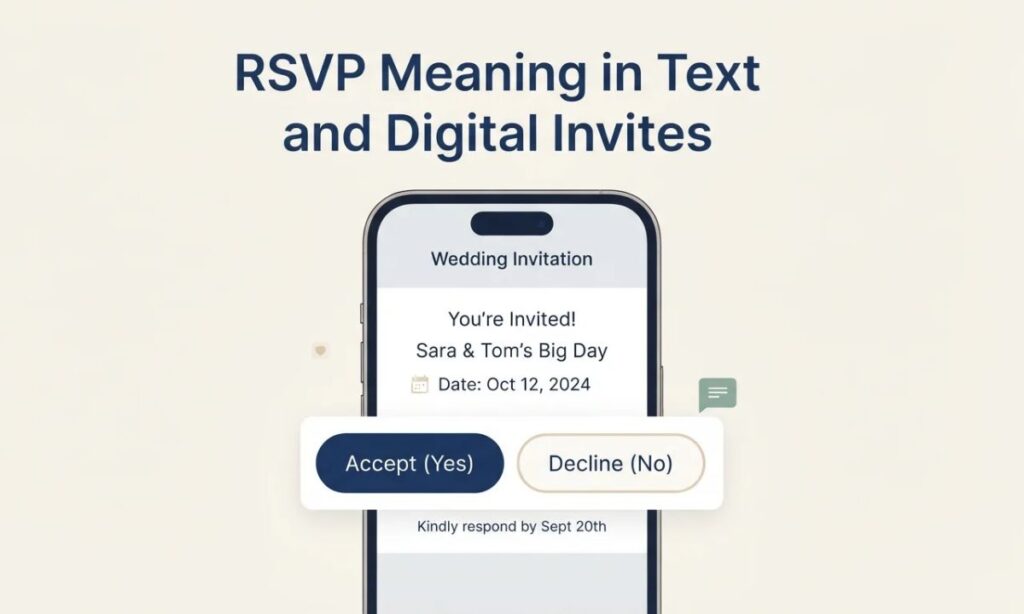
Many couples now collect replies on a wedding website, so the RSVP meaning often shows up as a button. You may select attendance, add meal choices and note dietary needs in a single form. Read each question carefully, and submit one reply per household only if the site says so.
RSVP in Casual Text Messages
In texts, “RSVP?” or “RSVP by Friday” asks friends to confirm. A simple “Yes, I’m in” or “Can’t make it, sorry” does the job. The RSVP meaning is still “please respond,” just in a lighter tone.
Does the Meaning Change in Digital Contexts?
No, the core RSVP meaning does not change online. Buttons such as “Going,” “Maybe” and “Can’t go” on event pages are just digital versions of the same request. The one difference is speed: because replying is so easy, hosts tend to expect answers faster.
Common RSVP Mistakes to Avoid

Ignoring the Request
The biggest mistake is not replying at all. Even a “no” is helpful, because it tells the host they can stop waiting. Ignoring the request goes against the RSVP meaning itself.
Changing Your Response Last-Minute
Switching from yes to no on the day is hard on hosts, especially when food has been paid for. If something truly unavoidable comes up, call or message the host personally and apologize.
Not Specifying Dietary Needs or Guest Count
Replying “yes” without saying who is coming or what you can eat leaves the host guessing. Add the number of guests and any food needs in the same message.
Frequently Asked Questions
What does RSVP stand for?
It stands for “répondez s’il vous plaît,” French for “please respond.” The RSVP meaning is a polite request for your answer.
Is RSVP always required?
If an invitation includes RSVP, the host expects a reply, because that is the RSVP meaning. The main exception is “regrets only,” where you answer only if you cannot attend.
What happens if you don’t RSVP?
The host may assume you are not coming, or may need to follow up. For weddings and catered events, your seat or meal may not be planned for.
Can you RSVP by text?
Yes, if the host invited you by text or says that is fine. For formal invitations, follow the method on the card.
What’s the difference between RSVP and “regrets only”?
A standard RSVP needs a reply from everyone, yes or no. With “regrets only,” you reply only if you cannot attend.
How late is too late to RSVP?
Any time after the host’s deadline is late. If you missed it, reply right away and apologize, and understand the host may not be able to add you.
Conclusion
The RSVP meaning is simple: please respond. Replying by the deadline, using the host’s method and sharing details such as guests and dietary needs makes you an easy and welcome guest.
When in doubt, answer quickly, keep it kind and let the host know if anything changes. A short message can save a host hours of worry.
