

Your friend texts “istg I’m going to scream” right after a bad day. Are they angry? Joking? Being dramatic? The same four letters can show up in a promise, a rant or a punchline.
That is why the ISTG meaning is worth knowing. This guide covers what it stands for, where it came from, how it differs from similar slang, and how to reply without stepping on anyone’s toes.
Quick Answer
ISTG means “I swear to God.” People use it in texts and on social media to stress that they are serious, frustrated or completely honest. It is informal slang, so it belongs in casual chats, not formal writing.
Key Takeaways
- ISTG stands for “I swear to God.”
- It adds emphasis to promises, complaints and reactions.
- The tone can be serious, annoyed, funny or dramatic.
- The ISTG meaning is the same on every platform.
- It comes from a religious phrase, so some people avoid it.
- Keep it out of work emails and formal messages.
What Does ISTG Mean in Text & Chat?
The ISTG meaning in text is “I swear to God.” It works as an intensifier. Instead of saying something plainly, you add ISTG to show you really mean it.
Examples:
- “Istg I locked the door.”
- “Istg if he cancels again, I’m done.”
- “Istg this song is perfect.”
Some people type it in capitals, while others use lowercase. Both versions mean the same thing. It often appears at the start of a sentence, though it can sit in the middle or at the end.
This core ISTG meaning rarely changes. What changes is the feeling around it, which could be anger, excitement or humor. People also stretch it with extra words, such as “istg on my life” or “istg I’m not lying,” to make the claim even stronger.
Where Did ISTG Come From?
ISTG traces back to AOL Instant Messenger-era texting culture, when people shortened common phrases to type faster. It was first documented on Urban Dictionary around 2007 to 2008.
Later, it surged through Tumblr, Twitter and TikTok, where short, punchy phrases spread quickly. Each platform added its own flavor. Tumblr used it in fandom rants, Twitter used it in dramatic one-liners, and TikTok turned it into captions and comments.
The ISTG meaning itself stayed steady through all of it. Only the places where people used it changed. That steady ISTG meaning is a big reason the abbreviation has lasted so long, even as other slang from the same era faded away.
Is ISTG Religious, or Just an Expression?
It is both, depending on who you ask. The phrase “I swear to God” is religious at its core, because it calls on God as a witness. Over time, though, it has become a secular expression that most people use as simple emphasis.
Still, the roots matter to some. Certain people find casual use of the phrase disrespectful, even in abbreviated form. Others see it as harmless, since most users are not thinking about religion at all.
Language often works this way. Many everyday words, such as “goodbye,” began as religious expressions and drifted into ordinary speech. The ISTG meaning followed a similar path.
The practical takeaway is simple. Treat the ISTG meaning as an emphasis phrase for most chats, but stay aware of your audience.
Is It Okay to Say ISTG to Someone Religious?
It depends on the person. If someone’s beliefs discourage casually invoking God’s name, ISTG can feel careless to them. Being considerate costs nothing.
Try these alternatives instead:
- “I swear”
- “Honestly”
- “For real”
- “I promise”
If you are not sure, take a cue from how the other person writes. When in doubt, a simple “I swear” gets the same point across.
How People Use ISTG in Daily Conversations
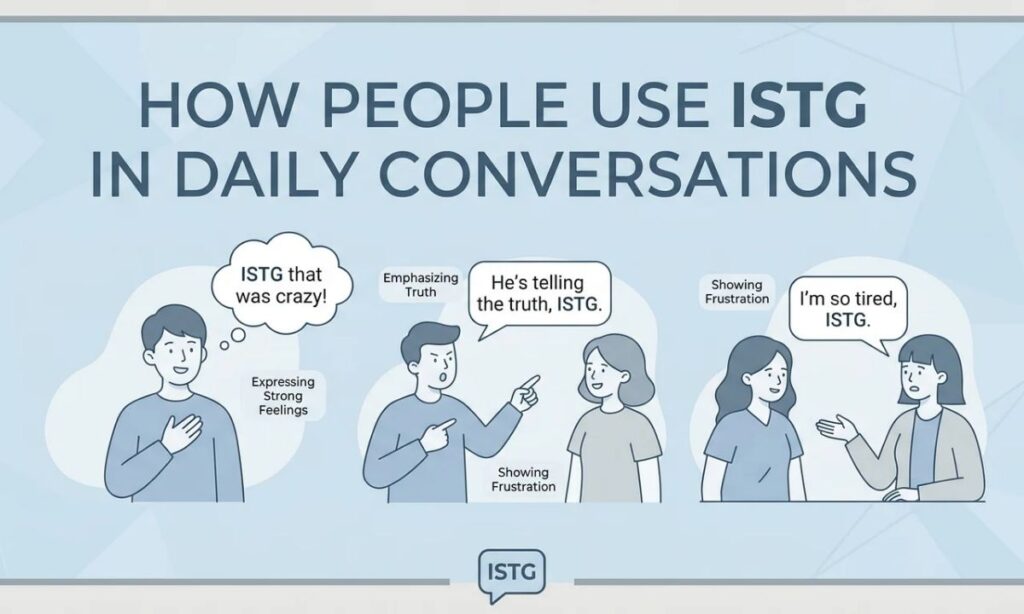
The ISTG meaning shifts slightly with the situation. Here are the four most common patterns, from serious to silly.
Serious Statements
ISTG can back up a sincere claim. “Istg I’m telling the truth” signals that the speaker wants to be believed.
Frustration
This is the most common use. “Istg this app crashes every time” pairs the abbreviation with irritation.
Funny or Dramatic Moments
Many people use it as a joke. “Istg my cat judges me” is playful exaggeration. The ISTG meaning here is closer to “I’m being dramatic on purpose.”
Emotional Reactions
It also shows strong feelings that are not angry. “Istg I cried at that ending” expresses a heartfelt reaction.
ISTG vs. ONG: What’s the Difference?
ISTG and ONG are close cousins. ONG means “on God.” Both add emphasis, but their feel is a little different.
| Feature | ISTG | ONG |
|---|---|---|
| Full form | I swear to God | On God |
| Typical tone | Emotional, frustrated | Casual, affirming |
| Common use | Rants, promises | Agreement, confidence |
| Example | “Istg I’m done.” | “That was good, ong.” |
ISTG often reads as more emotional or frustrated, while ONG sounds like a casual affirmation. Both share the same religious roots.
Variations of ISTG
“ISTFG” and “IFSTG”
These are intensified versions that add a profanity. ISTFG means “I swear to f***ing God,” and IFSTG is a rearranged form with the same idea. Both carry more heat, so they suit venting among close friends, not public posts or formal chats.
“ISTGFR”
ISTGFR combines ISTG with “for real.” It means “I swear to God, for real,” doubling the emphasis. People use it when they truly want to be believed.
ISTG Meaning on Different Platforms
The ISTG meaning does not change from app to app. Tone and style shift slightly.
On WhatsApp, ISTG appears in private chats and group threads, usually for venting or jokes with friends and family.
On Instagram, you will see it in comments, DMs and story replies. It often sits next to a reaction to a post or photo.
TikTok
On TikTok, ISTG shows up in captions and comments, often with humor or fandom excitement.
Snapchat
On Snapchat, it fits quick chats and short replies, especially between close friends.
X (Twitter)
On X, ISTG is common in short, dramatic posts. A tweet like “istg Mondays are a scam” is a typical example.
Common Misunderstandings
Thinking It’s Always Offensive
Most users do not mean ISTG as an insult or a religious statement. The everyday ISTG meaning is plain emphasis. Still, some listeners may be sensitive to it.
Assuming It Only Expresses Anger
The ISTG meaning covers more than anger. It can show excitement, honesty, shock or humor. Read the sentence around it, because the surrounding words show the feeling the speaker wants to share.
Misreading the Tone
Texting hides tone. A joking ISTG can look angry without a smile or emoji. When in doubt, ask or add an emoji to make your tone clear.
Similar Terms and Related Slang
ISTG sits among many emphasis phrases. Seeing the ISTG meaning next to its relatives makes the differences easier to spot.
| Term | Meaning | Example |
|---|---|---|
| ISTG | I swear to God | “Istg I’m tired.” |
| ONG | On God | “That’s true, ong.” |
| FR | For real | “That was great, fr.” |
| SMH | Shaking my head | “Smh, he forgot again.” |
| No Cap | No lie | “No cap, best pizza ever.” |
FR, no cap and ONG confirm that something is true. SMH shows disapproval. ISTG adds feeling to a promise or complaint.
Examples of ISTG in Real Chat Situations
Chat 1: Frustration
Jess: The Wi-Fi died again.
Mo: Istg, they said it was fixed.
Chat 2: Promise
Ravi: Did you really lock the door?
Lina: Istg I did. Check the camera.
Chat 3: Excitement
Amy: Did you hear the new album?
Ben: Istg it’s the best thing I’ve heard all year.
Across these three chats, the same four letters carry annoyance, honesty and excitement. Tone and topic tell you which one you are reading.
How to Reply When Someone Says ISTG
Your reply should match the mood. Check whether the person sounds angry, excited or joking, then pick a response that fits.
Casual Replies
- “Same, honestly.”
- “I believe you.”
- “Ugh, that sounds rough.”
Friendly Replies
- “I’m here if you need to vent.”
- “That’s so annoying. Want to talk?”
- “I’m on your side.”
Calm or Formal Replies
- “I understand. Let me help sort this out.”
- “Thanks for letting me know. I will look into it.”
Is ISTG Appropriate in Professional Messages?
No. ISTG is casual slang with a religious background, so it does not belong in business emails, school work or messages to managers. Even if your coworkers use slang in chat, a clear and polite tone protects your image. Use plain words such as “I assure you” or “I promise” instead.
Is ISTG Still Popular?
Yes. It remains common among teens and young adults, and the ISTG meaning is widely understood across age groups that use social media daily. New slang rises and falls quickly, but this phrase has held steady for years across social media and group chats.
Frequently Asked Questions
What does ISTG mean on Snapchat?
On Snapchat, ISTG means “I swear to God.” It adds emphasis to a promise or complaint.
Is ISTG rude?
Not usually. Most people use it casually, but some find invoking God’s name disrespectful.
Is ISTG religious?
The phrase has religious roots, but most people now use it as a secular expression of emphasis.
Can ISTG be used jokingly?
Yes. Many people use it for playful drama, like “istg my phone hates me.”
What’s the difference between ISTG and ONG?
ISTG often feels more emotional or frustrated, while ONG feels like a casual affirmation.
Should you use ISTG in professional messages?
No. It is casual slang, so use “I promise” or “I assure you” at work.
Conclusion
The ISTG meaning is simple: “I swear to God.” It adds emphasis to promises, complaints and reactions, and the tone depends on the person and the moment. It began in early chat culture and spread through Tumblr, Twitter and TikTok.
Use it with friends, choose gentler words around people who may find it disrespectful, and keep it out of formal writing. Next time someone says istg, you will know exactly what they mean.
